Public critique or private conversation? How to know what’s best for you.
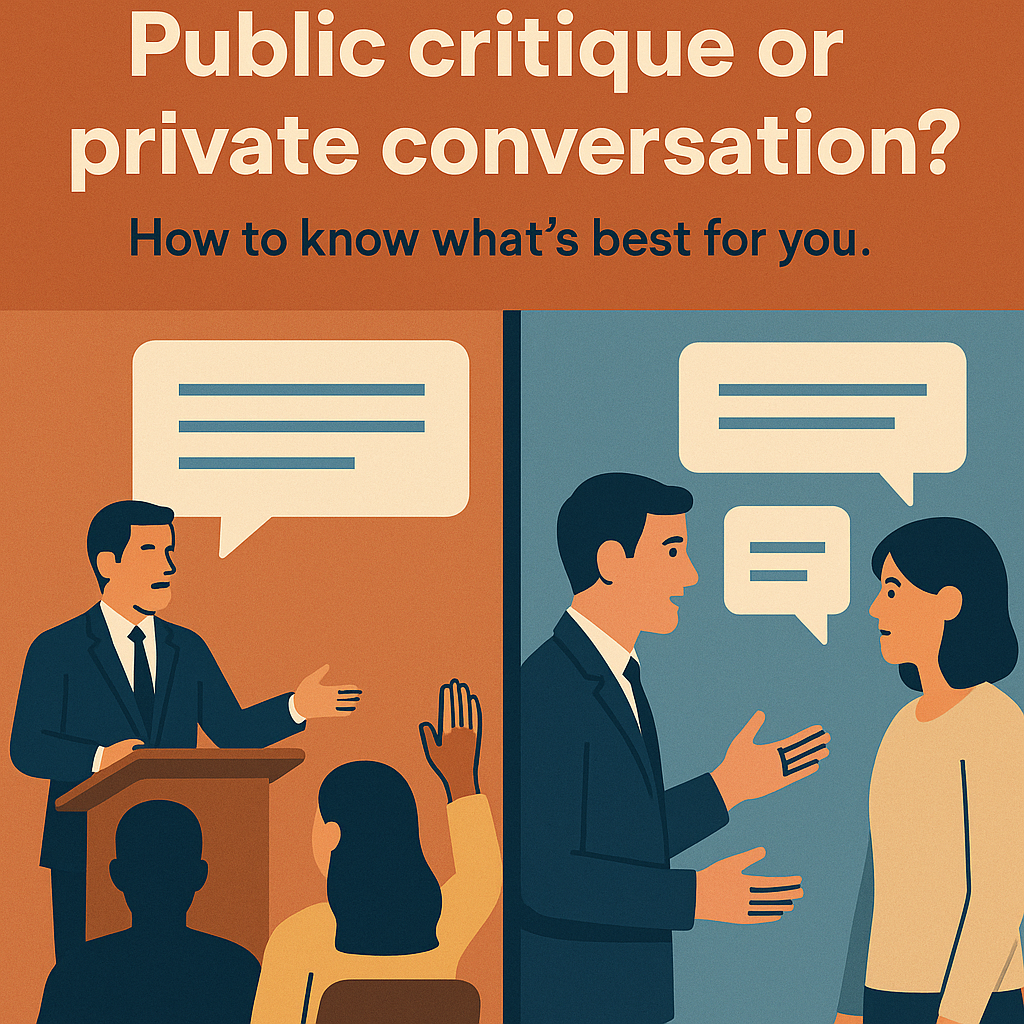
A few months ago, I and some colleagues at the University of Zurich gathered to discuss a recent paper in a leading ecology journal. During the discussion, I realised — or at least believed — that the paper contained an error. Depending on how one interpreted the error and the paper’s aims, it had the potential to mislead readers, especially students or early-career researchers still developing their understanding.
So, what should I do?
Should I write a formal comment, or post a critique in a public forum? Should I contact the author privately? Or should I do nothing, hoping others might notice and address the issue in their own way?
Which would you choose? It’s not an easy decision, especially without knowing the specifics — but many of us have faced similar moments. My point here is simple: you do have a choice, your choice matters, and it’s worth making it deliberately and reflectively.
Here’s how I approached it, guided by a few principles:
- I might be wrong.
- I don’t need or want to benefit personally from this.
- I want to help the community and relationships, not harm them.
- People should have the chance to address issues themselves.
- We should foster an environment where it’s safe to make and correct mistakes.
- Researchers should be accountable for what they publish.
Based on these, I decided a public critique — while perhaps justifiable — wasn’t the best first step. It could easily have read as confrontational or dismissive of the author’s work, and I wanted to avoid an adversarial exchange that might damage relationships or weaken our academic community.
Instead, I wrote to the author directly. I explained my concerns, and after some thoughtful back and forth, we had a productive exchange. The author was receptive, and eventually submitted a correction to the journal.
This experience reinforced a few things for me:
- Approach with humility and curiosity — I might be wrong, and listening matters.
- Private dialogue can work: it allows for nuance, mutual understanding, and a constructive outcome.
- Tone matters — I tried to centre the discussion on reasoning, not critique of the author.
- Expect defensiveness. Criticism, even of a small part of a paper, can feel personal.
- Expect misunderstanding, especially over email, where intentions and points can be misread.
- Stay focused. If the author raises tangential concerns, acknowledge them but gently steer the conversation back.
- Give space. Waiting a few days between responses can help keep things thoughtful rather than reactive.
Still, I have mixed feelings. I’m not sure the correction was sufficient, or that it will be noticed — it’s a small change in a large and growing body of literature, and many readers may never see it. That’s a common problem with post-publication corrections: important, but often invisible. I also don’t know whether a public comment would have reached more people, or been remembered for longer.
I’m in a fortunate position — I have long-term job security, and don’t feel a personal need to raise my profile. That wasn’t always the case; earlier in my career I engaged in more public back-and-forths, and may even have enjoyed them. But over time I’ve come to believe that public critiques, though sometimes necessary, often generate more heat than light. They can create a culture of defensiveness and fear rather than one of inquiry and humility.
Not always, though — I admire those who manage public critique with grace and generosity.
For me, the key realisation is this: how we critique each other’s work is just as important as the critique itself. Our choices shape the culture of our field — whether we cultivate curiosity and respect, or suspicion and hostility.
Have you faced a similar decision? How did you handle it? I’d be very interested to hear your thoughts.